
Evidence-based cycling planning: findings from the Nußdorferstraße real-world laboratory
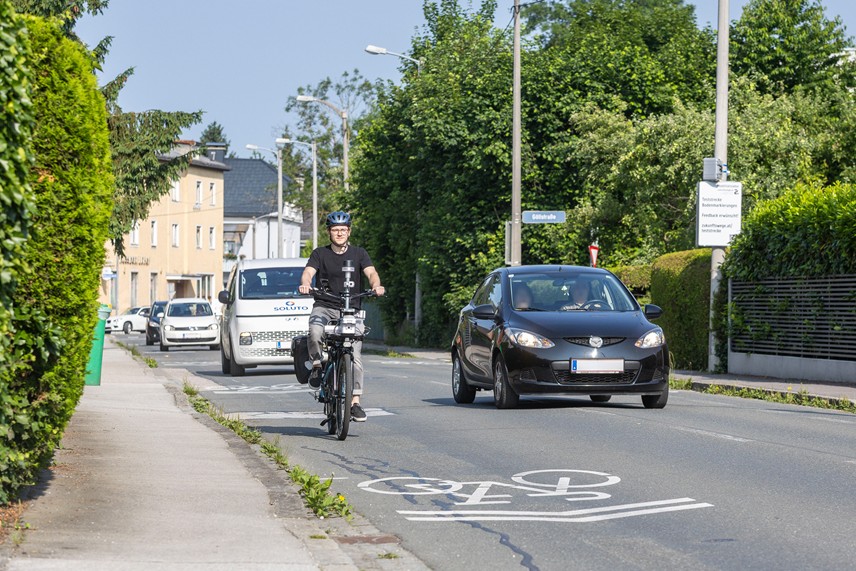
How do road markings affect overtaking behaviour around cyclists? The research bicycle used by Salzburg Research makes it possible to measure this objectively. Results from the Nußdorferstraße real-world laboratory show that targeted markings, particularly wide multi-purpose lanes with a narrow central carriageway, increase the overtaking distance between motor vehicles and cyclists.
How do road markings affect overtaking behaviour around cyclists? The research bicycle used by Salzburg Research makes it possible to measure this objectively. Results from the Nußdorferstraße real-world laboratory show that targeted markings, particularly wide multi-purpose lanes with a narrow central carriageway, increase the overtaking distance between motor vehicles and cyclists.
Since 2021, Salzburg Research has been using a specially developed research bicycle to analyse interactions between cyclists and other road users in public road space. The aim is to objectively record real-world traffic situations in order to support evidence-based conclusions on cycling safety.
A key focus is the investigation of overtaking manoeuvres between motor vehicles and bicycles. With the help of algorithms, vehicles are automatically detected in the measurement data, and their position and dimensions are determined. From this, key parameters such as overtaking distances and speed differences between motor vehicles and bicycles can be derived. These enable an objective assessment of the safety of different types of cycling infrastructure.
The methodology has already been applied in several research projects: in the RADBEST project, which tested solutions for safe cycle routing at bottlenecks in the DACH countries; in the Nußdorferstraße real-world laboratory in Salzburg; and in the MZSFreiland project, which investigates multi-purpose lanes with a narrow central carriageway on Austrian rural roads.
Nußdorferstraße real-world laboratory
The setup of the Nußdorferstraße real-world laboratory and the objectives of the test site have already been described in detail in a previous article, “How road markings influence overtaking behaviour: pilot projects in Salzburg”. It explains how different road markings were used on Nußdorferstraße to investigate the overtaking behaviour of motor vehicles towards cyclists and to test measures for improving road safety.
In the second half of 2025, two variants of road markings were tested in the Nußdorferstraße real-world laboratory. The study examined how two-metre-wide multi-purpose lanes with a narrow central carriageway, as well as large sharrows, affect the overtaking behaviour of motor vehicles.

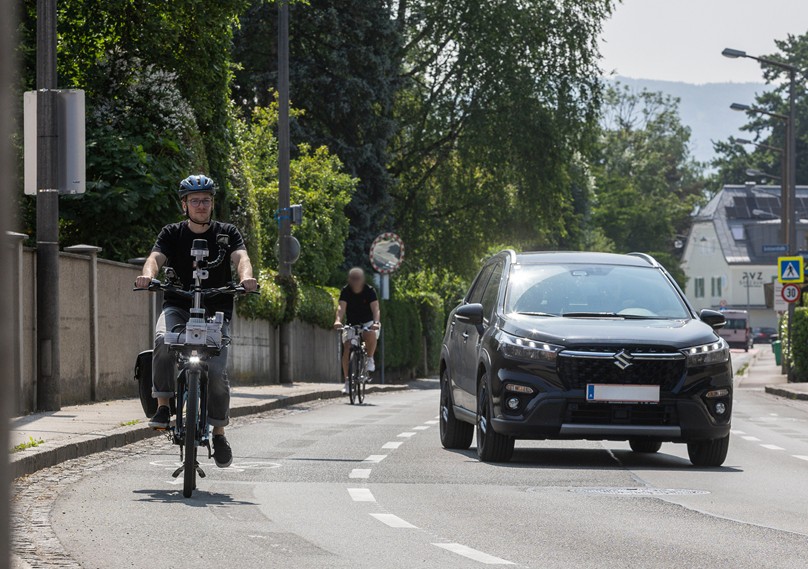

To analyse overtaking distances, Salzburg Research carried out test rides using a research bicycle on behalf of the mobility lab zukunftswege.at. These took place in two phases: in June and in September/October 2025. In addition, an online feedback tool was set up to gather road users’ subjective perceptions of safety. Feedback from the first phase showed that some motorists were unsettled by the new road markings. For the second phase, additional signs explaining the correct overtaking procedure were therefore installed.
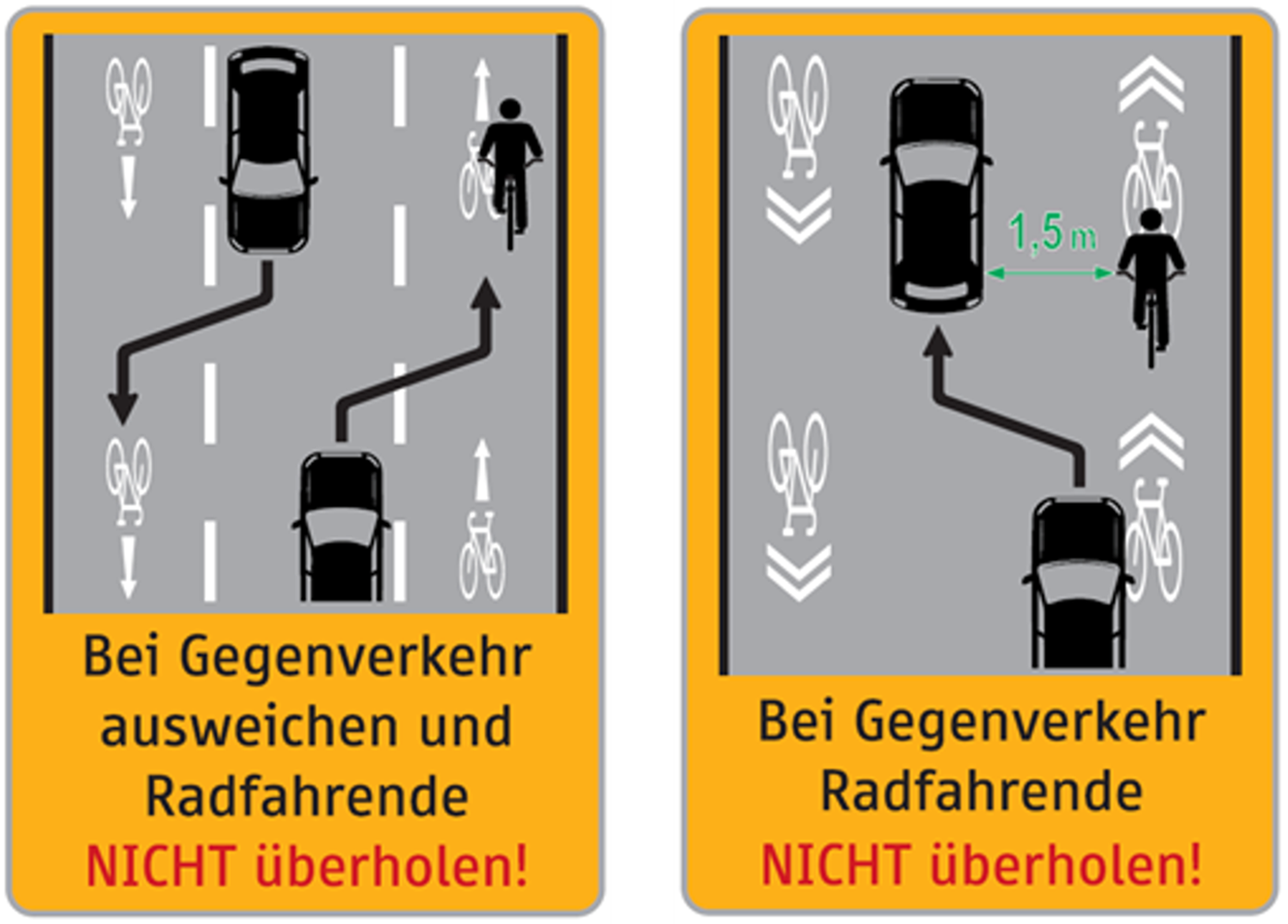
Signs for motorists indicating the desired overtaking behaviour. © Salzburg Verkehr
Trends in overtaking distances and speeds
A total of 356 overtaking manoeuvres were recorded along Nußdorferstraße. In the second survey phase, the median overtaking distance was 1.12 metres in the section with a wide multi-purpose lane and narrow central carriageway, and 1.05 metres in the section with large sharrows. This represents an increase in the overtaking distance in both variants compared with the first survey phase. However, at overtaking speeds of over 30 km/h, the legally prescribed minimum passing distance of 1.50 metres was still not achieved.
Oncoming traffic is a significant factor influencing the overtaking distance. A positive finding is that some motorists demonstrably delay their overtaking manoeuvre and remain behind cyclists until the traffic situation in the oncoming lane allows them to overtake.
The 30 km/h speed limit introduced on Nußdorferstraße also contributes to improved road safety. Lower speeds were recorded in the section with wide multi-purpose lanes than in the section with large sharrows. During the overtaking manoeuvres themselves, speeds were similar in both sections, as were the speed differences between motor vehicles and bicycles. This suggests a certain degree of consideration on the part of motorists when overtaking.
Feedback from road users
A total of 442 responses were received regarding the road marking trial. Sixty per cent of cyclists felt safer on the section with wide multi-purpose lanes than before, compared with 53 per cent on the section with large sharrows. Around a quarter of cyclists stated that they did not feel safer.
The proportion of cyclists who felt safe or very safe was higher in the section with the wide multi-purpose lane. Here, it stood at 40 per cent, compared with 30 per cent in the section with large sharrows. Among motorists, the markings were perceived as clear or unclear by roughly half of respondents in each case, with the wide multi-purpose lane being perceived as very unclear by one third of motorists.
Recommendations for further implementation
The overall findings were evaluated by con.sens mobilitätsdesign, and recommendations for action were derived from them. Both marking variants have generally proved to be effective. The variant with wide multi-purpose lanes and a narrow central carriageway has a greater impact on overtaking distances and is perceived as safer by a larger number of cyclists. However, this marking solution is less intuitive for motorists. The large sharrows provide cyclists with slightly less subjective safety, but are easier to implement on road sections with numerous traffic lights and/or roundabouts.
For Nußdorferstraße, it is recommended that wide multi-purpose lanes with a narrow central carriageway be implemented along its entire length in the future. The existing section will remain unchanged, while in the second section the large sharrows are to be replaced by wide multi-purpose lanes.
The results show how data collected with the research bicycle can be translated into evidence-based planning and evaluation of cycling infrastructure, providing cities and municipalities with a sound basis for decision-making. This makes it possible to address specific weaknesses in cycling infrastructure, increase perceived safety and promote cycling in the long term.
Background information on the project
The Nußdorferstraße real-world laboratory was implemented in 2025 by the mobility lab zukunftswege.at in collaboration with Salzburg Research and con.sens mobilitätsdesign, on behalf of the City of Salzburg.
www.zukunftswege.at/teststrecke/
Contact for enquiries:
Salzburg Research, Cornelia Zankl, cornelia.zankl@salzburgresearch.at
Radkompetenz members involved:
con.sens mobilitätsdesign, Salzburg Research
Cycling Competence Members in this article:
More articles with this member:
[crp]
Share this article:
Evidence-based cycling planning: findings from the Nußdorferstraße real-world laboratory
Share this article:
How do road markings affect overtaking behaviour around cyclists? The research bicycle used by Salzburg Research makes it possible to measure this objectively. Results from the Nußdorferstraße real-world laboratory show that targeted markings, particularly wide multi-purpose lanes with a narrow central carriageway, increase the overtaking distance between motor vehicles and cyclists.
How do road markings affect overtaking behaviour around cyclists? The research bicycle used by Salzburg Research makes it possible to measure this objectively. Results from the Nußdorferstraße real-world laboratory show that targeted markings, particularly wide multi-purpose lanes with a narrow central carriageway, increase the overtaking distance between motor vehicles and cyclists.
Since 2021, Salzburg Research has been using a specially developed research bicycle to analyse interactions between cyclists and other road users in public road space. The aim is to objectively record real-world traffic situations in order to support evidence-based conclusions on cycling safety.
A key focus is the investigation of overtaking manoeuvres between motor vehicles and bicycles. With the help of algorithms, vehicles are automatically detected in the measurement data, and their position and dimensions are determined. From this, key parameters such as overtaking distances and speed differences between motor vehicles and bicycles can be derived. These enable an objective assessment of the safety of different types of cycling infrastructure.
The methodology has already been applied in several research projects: in the RADBEST project, which tested solutions for safe cycle routing at bottlenecks in the DACH countries; in the Nußdorferstraße real-world laboratory in Salzburg; and in the MZSFreiland project, which investigates multi-purpose lanes with a narrow central carriageway on Austrian rural roads.
Nußdorferstraße real-world laboratory
The setup of the Nußdorferstraße real-world laboratory and the objectives of the test site have already been described in detail in a previous article, “How road markings influence overtaking behaviour: pilot projects in Salzburg”. It explains how different road markings were used on Nußdorferstraße to investigate the overtaking behaviour of motor vehicles towards cyclists and to test measures for improving road safety.
In the second half of 2025, two variants of road markings were tested in the Nußdorferstraße real-world laboratory. The study examined how two-metre-wide multi-purpose lanes with a narrow central carriageway, as well as large sharrows, affect the overtaking behaviour of motor vehicles.
To analyse overtaking distances, Salzburg Research carried out test rides using a research bicycle on behalf of the mobility lab zukunftswege.at. These took place in two phases: in June and in September/October 2025. In addition, an online feedback tool was set up to gather road users’ subjective perceptions of safety. Feedback from the first phase showed that some motorists were unsettled by the new road markings. For the second phase, additional signs explaining the correct overtaking procedure were therefore installed.
Signs for motorists indicating the desired overtaking behaviour. © Salzburg Verkehr
Trends in overtaking distances and speeds
A total of 356 overtaking manoeuvres were recorded along Nußdorferstraße. In the second survey phase, the median overtaking distance was 1.12 metres in the section with a wide multi-purpose lane and narrow central carriageway, and 1.05 metres in the section with large sharrows. This represents an increase in the overtaking distance in both variants compared with the first survey phase. However, at overtaking speeds of over 30 km/h, the legally prescribed minimum passing distance of 1.50 metres was still not achieved.
Oncoming traffic is a significant factor influencing the overtaking distance. A positive finding is that some motorists demonstrably delay their overtaking manoeuvre and remain behind cyclists until the traffic situation in the oncoming lane allows them to overtake.
The 30 km/h speed limit introduced on Nußdorferstraße also contributes to improved road safety. Lower speeds were recorded in the section with wide multi-purpose lanes than in the section with large sharrows. During the overtaking manoeuvres themselves, speeds were similar in both sections, as were the speed differences between motor vehicles and bicycles. This suggests a certain degree of consideration on the part of motorists when overtaking.
Feedback from road users
A total of 442 responses were received regarding the road marking trial. Sixty per cent of cyclists felt safer on the section with wide multi-purpose lanes than before, compared with 53 per cent on the section with large sharrows. Around a quarter of cyclists stated that they did not feel safer.
The proportion of cyclists who felt safe or very safe was higher in the section with the wide multi-purpose lane. Here, it stood at 40 per cent, compared with 30 per cent in the section with large sharrows. Among motorists, the markings were perceived as clear or unclear by roughly half of respondents in each case, with the wide multi-purpose lane being perceived as very unclear by one third of motorists.
Recommendations for further implementation
The overall findings were evaluated by con.sens mobilitätsdesign, and recommendations for action were derived from them. Both marking variants have generally proved to be effective. The variant with wide multi-purpose lanes and a narrow central carriageway has a greater impact on overtaking distances and is perceived as safer by a larger number of cyclists. However, this marking solution is less intuitive for motorists. The large sharrows provide cyclists with slightly less subjective safety, but are easier to implement on road sections with numerous traffic lights and/or roundabouts.
For Nußdorferstraße, it is recommended that wide multi-purpose lanes with a narrow central carriageway be implemented along its entire length in the future. The existing section will remain unchanged, while in the second section the large sharrows are to be replaced by wide multi-purpose lanes.
The results show how data collected with the research bicycle can be translated into evidence-based planning and evaluation of cycling infrastructure, providing cities and municipalities with a sound basis for decision-making. This makes it possible to address specific weaknesses in cycling infrastructure, increase perceived safety and promote cycling in the long term.
Background information on the project
The Nußdorferstraße real-world laboratory was implemented in 2025 by the mobility lab zukunftswege.at in collaboration with Salzburg Research and con.sens mobilitätsdesign, on behalf of the City of Salzburg.
www.zukunftswege.at/teststrecke/
Contact for enquiries:
Salzburg Research, Cornelia Zankl, cornelia.zankl@salzburgresearch.at
Radkompetenz members involved:
con.sens mobilitätsdesign, Salzburg Research
Cycling Competence Members in this article:
More articles with this member:
[crp]