
Active2Public Transport: Integrating Cycling and Public Transport in Practice
The EU project Active2Public Transport (A2PT) investigated how active mobility and public transport can be more effectively combined. Project partners included members of Radkompetenz Austria: BMIMI klimaaktiv mobil, the Mobility Centre Burgenland, and Verracon.
A key component of the project was a hands-on pilot scheme titled “Give your car a break”, which allowed participants to test multimodal mobility in everyday life. Around 50 participants in the Danube region received a free bicycle and a monthly public transport ticket. Similar pilot schemes were implemented in Burgenland, Bucharest, Bratislava and Olomouc, providing participants with e-bikes, folding bikes or cargo bikes combined with public transport tickets.
The results highlight the potential of combining cycling and public transport – as well as the conditions required to make this integration work in practice.
Testing multimodal mobility in everyday life
The effects of the pilot in Burgenland were measurable: seven participants changed their travel behaviour, approximately 200–300 car trips were replaced, and average savings amounted to €207.50 per person. Low-threshold access to bicycles and public transport significantly increased acceptance of multimodal mobility.
“I can hardly believe that we have not needed a car for almost three weeks… with the electric bike, you can get everywhere without much effort,” says Sabine (44) from the Ulm/Neu-Ulm region. Over a period of four weeks, she carried out her daily trips using public transport, cycling and walking.
In the Ulm/Neu-Ulm metropolitan area, a full shift away from car use remained the exception. However, most participants – nine out of 13 – reduced their car use in favour of active mobility and public transport after the trial.
Infrastructure as a key factor for combining cycling and public transport
The pilot activities also revealed gaps in infrastructure and service quality. Missing or inadequate cycling connections, as well as limited service quality in bus and rail systems, make intermodal travel more difficult.
Multimodal accessibility checks at 45 public transport stops across the Danube region confirmed these findings. In rural areas in particular, safe connections between municipalities and public transport nodes are often lacking, making the car the more convenient option.
In Burgenland, this situation is expected to improve gradually. Based on the analysis, concrete recommendations were developed and compiled in the “Checklist for PT stations and surrounding”. This document defines not only standards for the stops themselves, but also for walking and cycling access routes in their surrounding catchment areas.
Secure bicycle parking at public transport stop
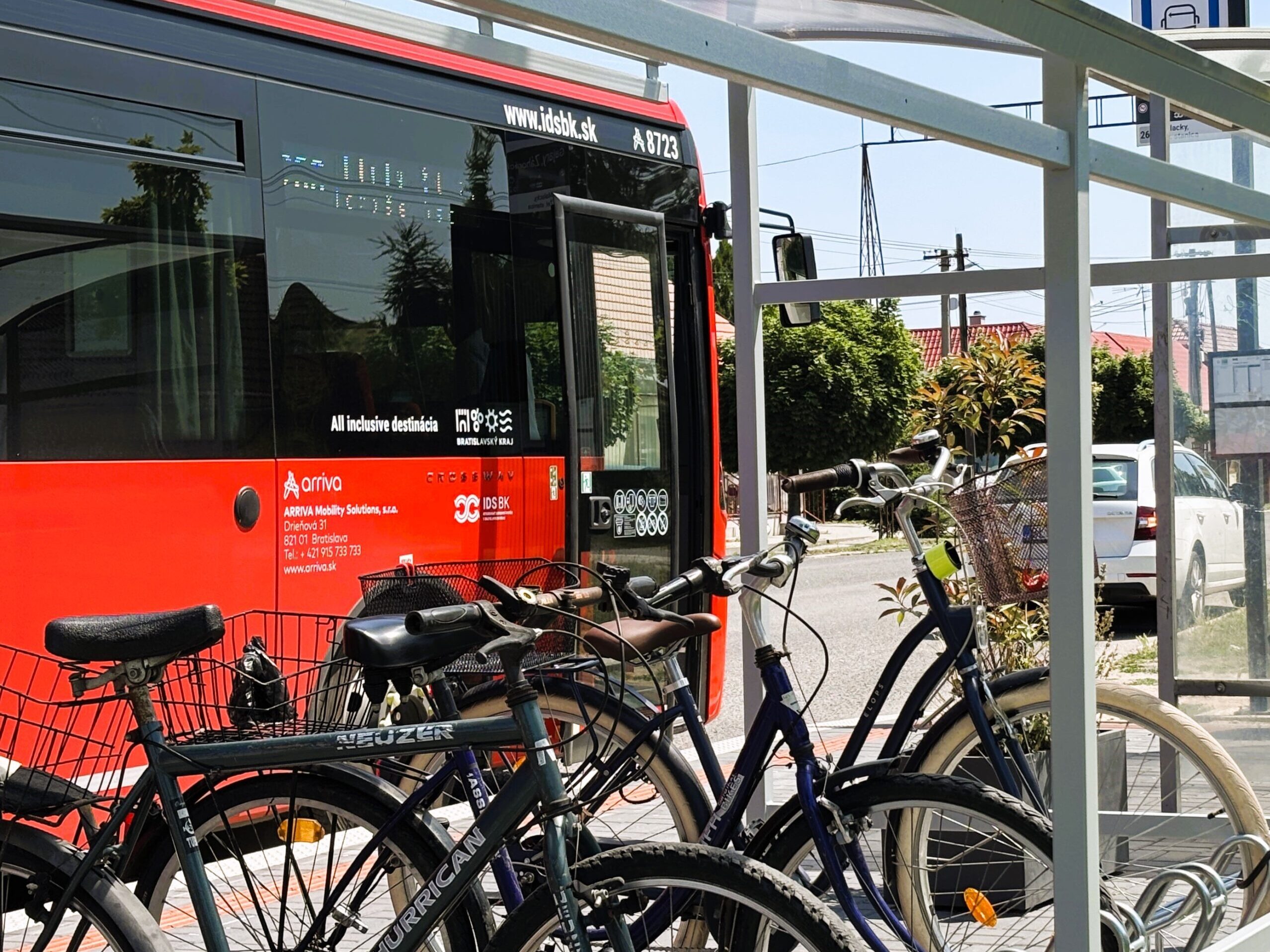
Bratislava, Slowakei – cycle parking facility at a bus stop © Šimon Juřík BID
Alongside good network integration, the design of the stop itself plays a central role. A key minimum standard is high-quality bicycle parking facilities: simple, easy-to-use racks located close to the entrance in urban areas.
In rural contexts, integrated bicycle racks directly at shelters are increasingly becoming standard. The guideline recommends equipping all stops with sufficient cycling demand with secure, barrier-free and, where possible, weather-protected bicycle parking facilities.
At regional transport hubs, larger covered and well-lit bicycle parking facilities are required. At major stations, a mix of racks, covered parking spaces and bicycle boxes near all station exits is recommended.
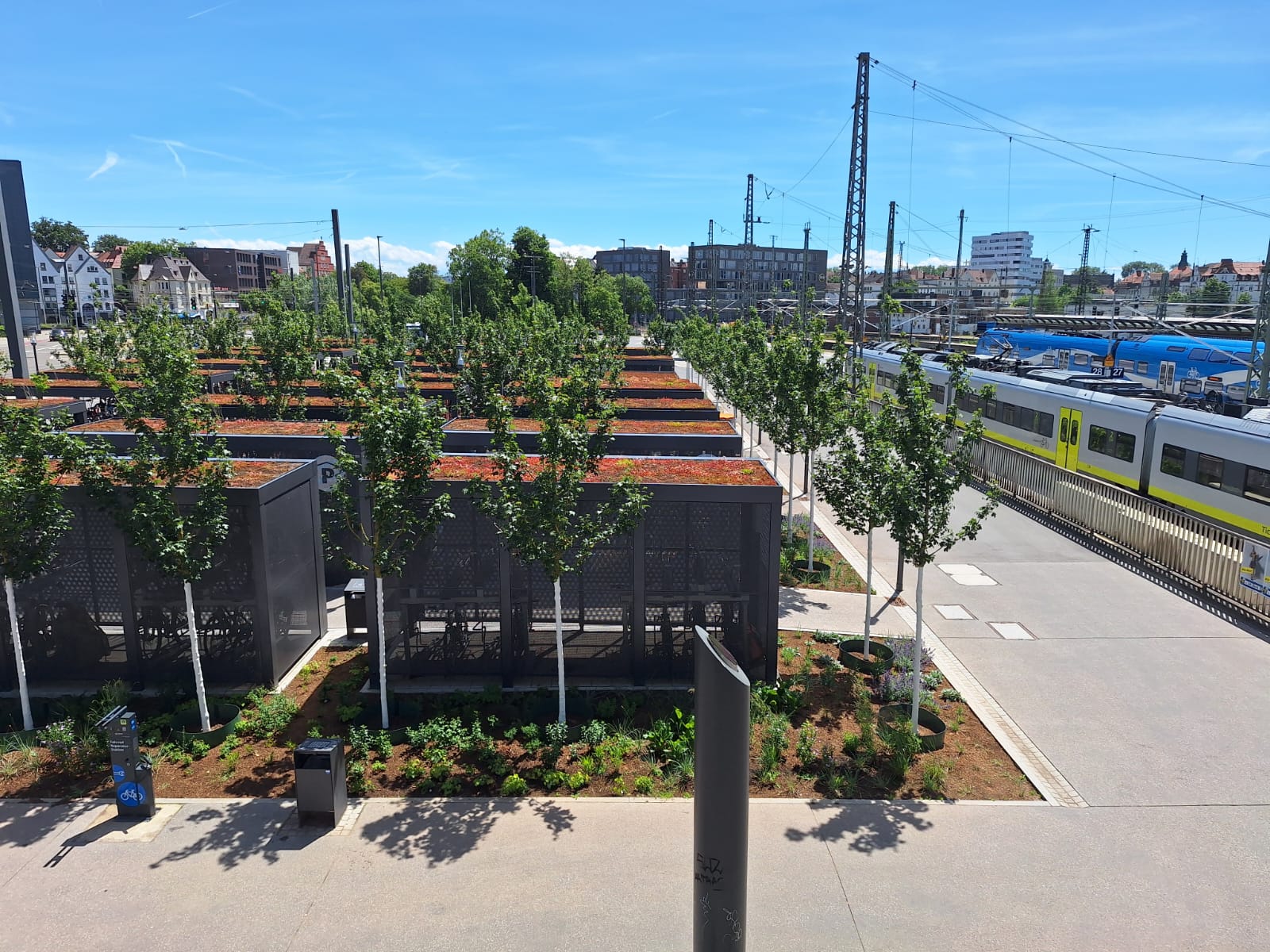
Ulm railway station bicycle parking, Germany © Annika Morath
Large-scale bicycle parking facilities such as those in Ghent (Belgium), Utrecht (Netherlands) or the bicycle parking hall at Gare du Nord in Paris (France) are still rare in the Danube region. However, individual examples, such as the new bicycle parking facility at Ulm railway station, indicate the direction of development.
Bicycle boxes for secure long-term parking
Bicycle boxes provide additional secure long-term parking, particularly for high-value bicycles and e-bikes. In Austria, early installations exist in Vorarlberg, Salzburg, Vienna and Wulkaprodersdorf in Burgenland, where they are mainly used by commuters.
Within the project, similar systems were tested in Slovenia and, for the first time, in Serbia.
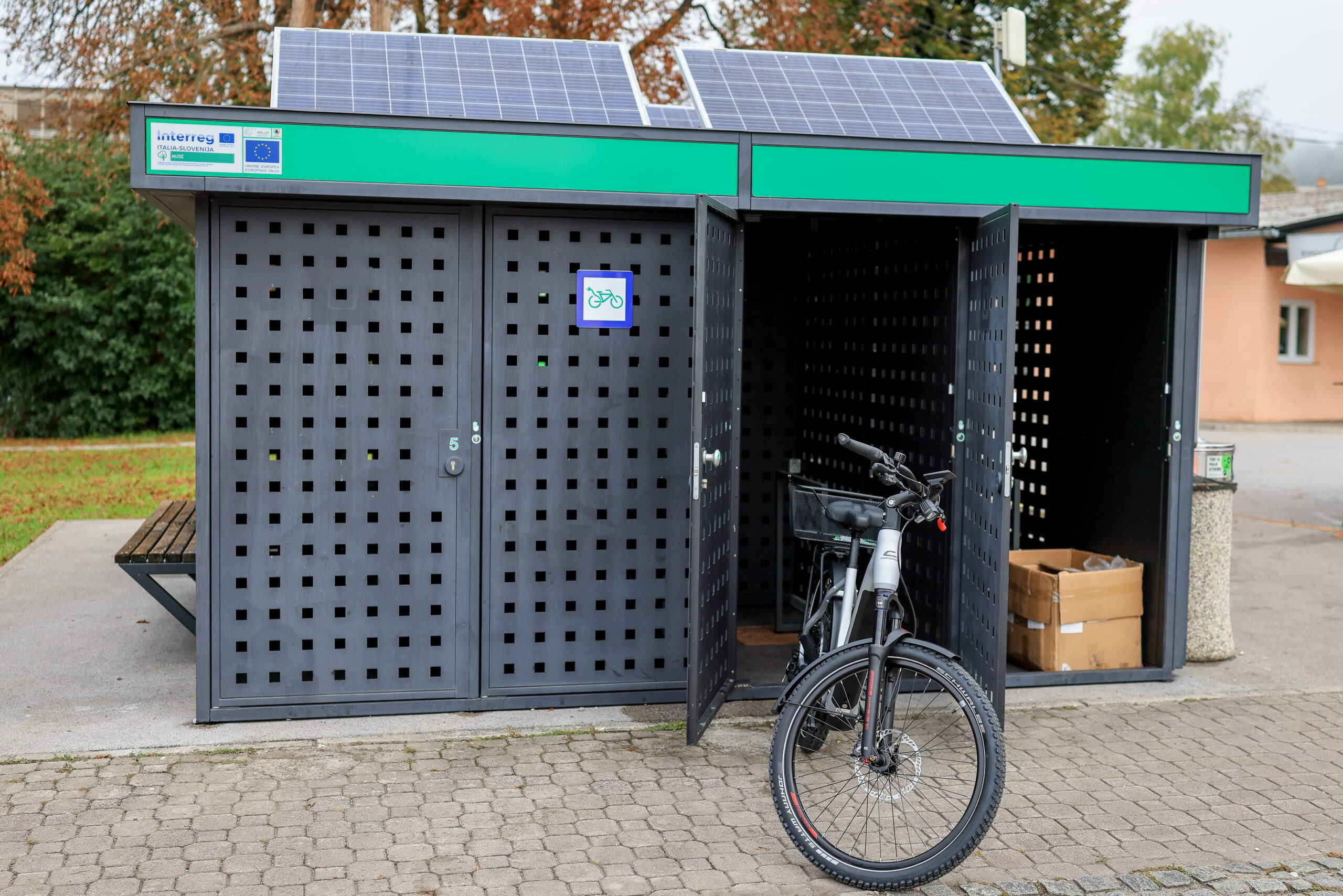
Bicycle boxes in Grosuplje, Slovenia © MOPE
In Grosuplje (Slovenia), existing bicycle boxes were technically upgraded. A mechanical key system – previously prone to failure and maintenance issues – was replaced with digital locks similar to hotel safes. In addition, underused bicycle boxes at the station were promoted via a social media campaign. Feedback was largely positive, particularly regarding security, convenience and ease of use.
Cooperation and governance as success factors
At the same time, delays – for example in Novi Beograd (Serbia) – highlight the importance of institutional frameworks. Despite initial strong interest from local stakeholders, it remained unclear for several months who owned and controlled the land on which the bicycle boxes were to be installed.
Unclear responsibilities and property issues between the railway operator, bus operator and the City of Belgrade delayed implementation.
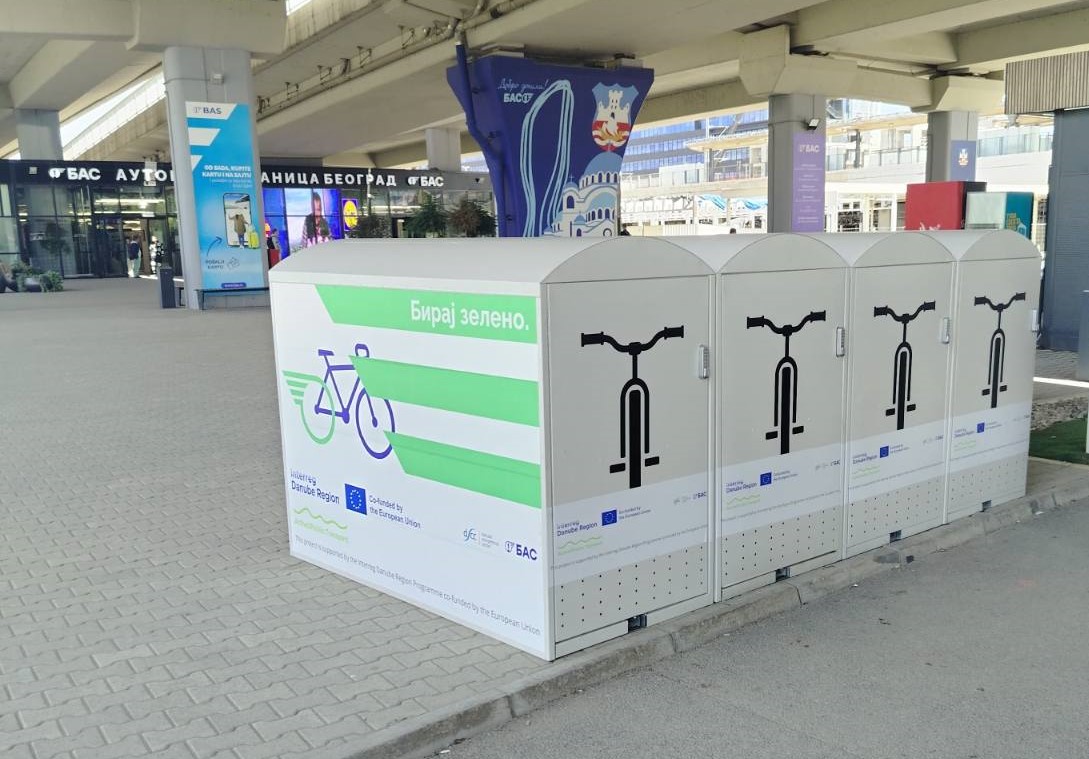
Novi Beograd bus station bicycle boxes, Serbia © DCC
Novi Beograd is not an isolated case in the Danube region or in Europe. Such situations are typical for major public transport nodes and illustrate that implementing measures in station areas is a complex multi-stakeholder process. Sufficient time for coordination, planning and implementation is therefore essential – even for relatively small interventions such as adding bicycle parking at station forecourts.
Conclusion
The experience from the Active2Public Transport project demonstrates the strong potential of combining cycling and public transport. However, success depends on three key factors: safe access routes to stations, high-quality parking facilities, and effective cooperation between stakeholders.
All results from seven pilot actions and more than 30 good practice examples have been compiled in an English-language toolbox. These practical solutions for improving the integration of active mobility and public transport are structured into ten key action fields and guiding principles for practitioners.
Further Links:
- A2P-Online-Toolbox: Active2Public Transport: Multimodal Mobility System | klimaaktiv
- Checklist for PT stations and surrounding: https://www.burgenland.at/themen/default-b2140753f9/oeffentlicher-verkehr/leitfaden-haltestellenausstattung/
Recommended readings (project team)
- A2PT pilot actions::
- Good practice examples:
This project was co-financed by the Danube Region Interreg Programme with EU funding, initiated by the Federal Ministry for Innovation, Mobility and Infrastructure (BMIMI), and implemented by the Austrian Energy Agency as lead partner in cooperation with klimaaktiv mobil.
Cycling Competence Members in this article:
More articles with this member:
[crp]
Share this article:
Active2Public Transport: Integrating Cycling and Public Transport in Practice
Share this article:
The EU project Active2Public Transport (A2PT) investigated how active mobility and public transport can be more effectively combined. Project partners included members of Radkompetenz Austria: BMIMI klimaaktiv mobil, the Mobility Centre Burgenland, and Verracon.
A key component of the project was a hands-on pilot scheme titled “Give your car a break”, which allowed participants to test multimodal mobility in everyday life. Around 50 participants in the Danube region received a free bicycle and a monthly public transport ticket. Similar pilot schemes were implemented in Burgenland, Bucharest, Bratislava and Olomouc, providing participants with e-bikes, folding bikes or cargo bikes combined with public transport tickets.
The results highlight the potential of combining cycling and public transport – as well as the conditions required to make this integration work in practice.
Testing multimodal mobility in everyday life
The effects of the pilot in Burgenland were measurable: seven participants changed their travel behaviour, approximately 200–300 car trips were replaced, and average savings amounted to €207.50 per person. Low-threshold access to bicycles and public transport significantly increased acceptance of multimodal mobility.
“I can hardly believe that we have not needed a car for almost three weeks… with the electric bike, you can get everywhere without much effort,” says Sabine (44) from the Ulm/Neu-Ulm region. Over a period of four weeks, she carried out her daily trips using public transport, cycling and walking.
In the Ulm/Neu-Ulm metropolitan area, a full shift away from car use remained the exception. However, most participants – nine out of 13 – reduced their car use in favour of active mobility and public transport after the trial.
Infrastructure as a key factor for combining cycling and public transport
The pilot activities also revealed gaps in infrastructure and service quality. Missing or inadequate cycling connections, as well as limited service quality in bus and rail systems, make intermodal travel more difficult.
Multimodal accessibility checks at 45 public transport stops across the Danube region confirmed these findings. In rural areas in particular, safe connections between municipalities and public transport nodes are often lacking, making the car the more convenient option.
In Burgenland, this situation is expected to improve gradually. Based on the analysis, concrete recommendations were developed and compiled in the “Checklist for PT stations and surrounding”. This document defines not only standards for the stops themselves, but also for walking and cycling access routes in their surrounding catchment areas.
Secure bicycle parking at public transport stop
Bratislava, Slowakei – cycle parking facility at a bus stop © Šimon Juřík BID
Alongside good network integration, the design of the stop itself plays a central role. A key minimum standard is high-quality bicycle parking facilities: simple, easy-to-use racks located close to the entrance in urban areas.
In rural contexts, integrated bicycle racks directly at shelters are increasingly becoming standard. The guideline recommends equipping all stops with sufficient cycling demand with secure, barrier-free and, where possible, weather-protected bicycle parking facilities.
At regional transport hubs, larger covered and well-lit bicycle parking facilities are required. At major stations, a mix of racks, covered parking spaces and bicycle boxes near all station exits is recommended.
Ulm railway station bicycle parking, Germany © Annika Morath
Large-scale bicycle parking facilities such as those in Ghent (Belgium), Utrecht (Netherlands) or the bicycle parking hall at Gare du Nord in Paris (France) are still rare in the Danube region. However, individual examples, such as the new bicycle parking facility at Ulm railway station, indicate the direction of development.
Bicycle boxes for secure long-term parking
Bicycle boxes provide additional secure long-term parking, particularly for high-value bicycles and e-bikes. In Austria, early installations exist in Vorarlberg, Salzburg, Vienna and Wulkaprodersdorf in Burgenland, where they are mainly used by commuters.
Within the project, similar systems were tested in Slovenia and, for the first time, in Serbia.
Bicycle boxes in Grosuplje, Slovenia © MOPE
In Grosuplje (Slovenia), existing bicycle boxes were technically upgraded. A mechanical key system – previously prone to failure and maintenance issues – was replaced with digital locks similar to hotel safes. In addition, underused bicycle boxes at the station were promoted via a social media campaign. Feedback was largely positive, particularly regarding security, convenience and ease of use.
Cooperation and governance as success factors
At the same time, delays – for example in Novi Beograd (Serbia) – highlight the importance of institutional frameworks. Despite initial strong interest from local stakeholders, it remained unclear for several months who owned and controlled the land on which the bicycle boxes were to be installed.
Unclear responsibilities and property issues between the railway operator, bus operator and the City of Belgrade delayed implementation.
Novi Beograd bus station bicycle boxes, Serbia © DCC
Novi Beograd is not an isolated case in the Danube region or in Europe. Such situations are typical for major public transport nodes and illustrate that implementing measures in station areas is a complex multi-stakeholder process. Sufficient time for coordination, planning and implementation is therefore essential – even for relatively small interventions such as adding bicycle parking at station forecourts.
Conclusion
The experience from the Active2Public Transport project demonstrates the strong potential of combining cycling and public transport. However, success depends on three key factors: safe access routes to stations, high-quality parking facilities, and effective cooperation between stakeholders.
All results from seven pilot actions and more than 30 good practice examples have been compiled in an English-language toolbox. These practical solutions for improving the integration of active mobility and public transport are structured into ten key action fields and guiding principles for practitioners.
Further Links:
- A2P-Online-Toolbox: Active2Public Transport: Multimodal Mobility System | klimaaktiv
- Checklist for PT stations and surrounding: https://www.burgenland.at/themen/default-b2140753f9/oeffentlicher-verkehr/leitfaden-haltestellenausstattung/
Recommended readings (project team)
- A2PT pilot actions::
- Good practice examples:
This project was co-financed by the Danube Region Interreg Programme with EU funding, initiated by the Federal Ministry for Innovation, Mobility and Infrastructure (BMIMI), and implemented by the Austrian Energy Agency as lead partner in cooperation with klimaaktiv mobil.
Cycling Competence Members in this article:
More articles with this member:
[crp]