
Vienna redesigns the Ringstraße for walking and cycling
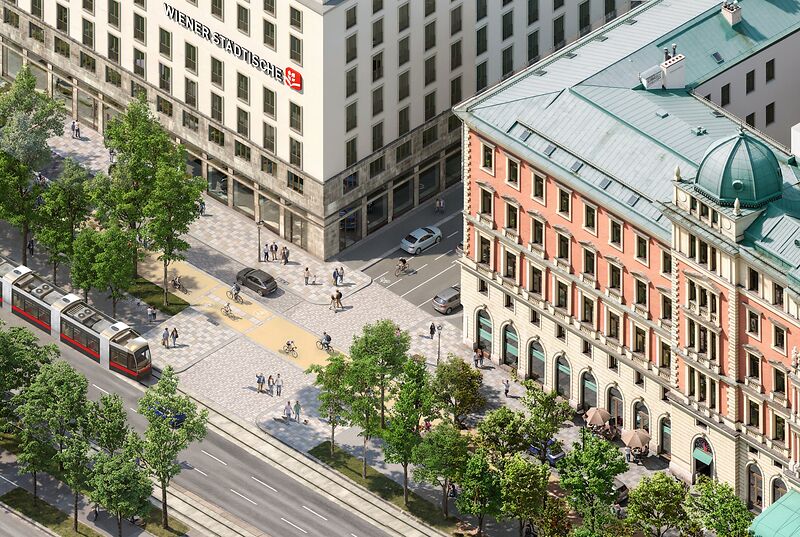
With thousands of pedestrians and cyclists every day, Vienna’s Ringstraße is one of the most heavily used urban street spaces in Austria. It brings together high levels of walking and cycling traffic, dense public transport services and major historic urban spaces within a very constrained corridor. The shared pedestrian and cycling paths along the Ring are increasingly reaching their capacity limits. The planned redesign of the side spaces, starting in autumn 2026, aims to respond more effectively to these diverse requirements.
Today, the shared pedestrian and cycling paths on both sides of the Ring are narrow and difficult to navigate. This regularly leads to conflicts between pedestrians and cyclists. Cycling volumes along the Ring are already very high – in 2025, an average of around 4,000 cyclists per day was counted on both the inner and outer sections of Opernring. The current layout no longer meets contemporary standards in cycling infrastructure design. As a result, the City of Vienna has decided to redesign the pedestrian and cycling infrastructure along the Ring.
Integrated planning approach
A key objective is to reduce conflicts between walking and cycling while strengthening the historic identity of the Ring. The historic pedestrian promenade between the service road and the main carriageway will once again be dedicated exclusively to walking. The current service road will be transformed into a cycling boulevard (Rad-Allee) – largely free of motorised traffic – as illustrated by Radkompetenz member Vienna Mobility Agency in the following graphic:
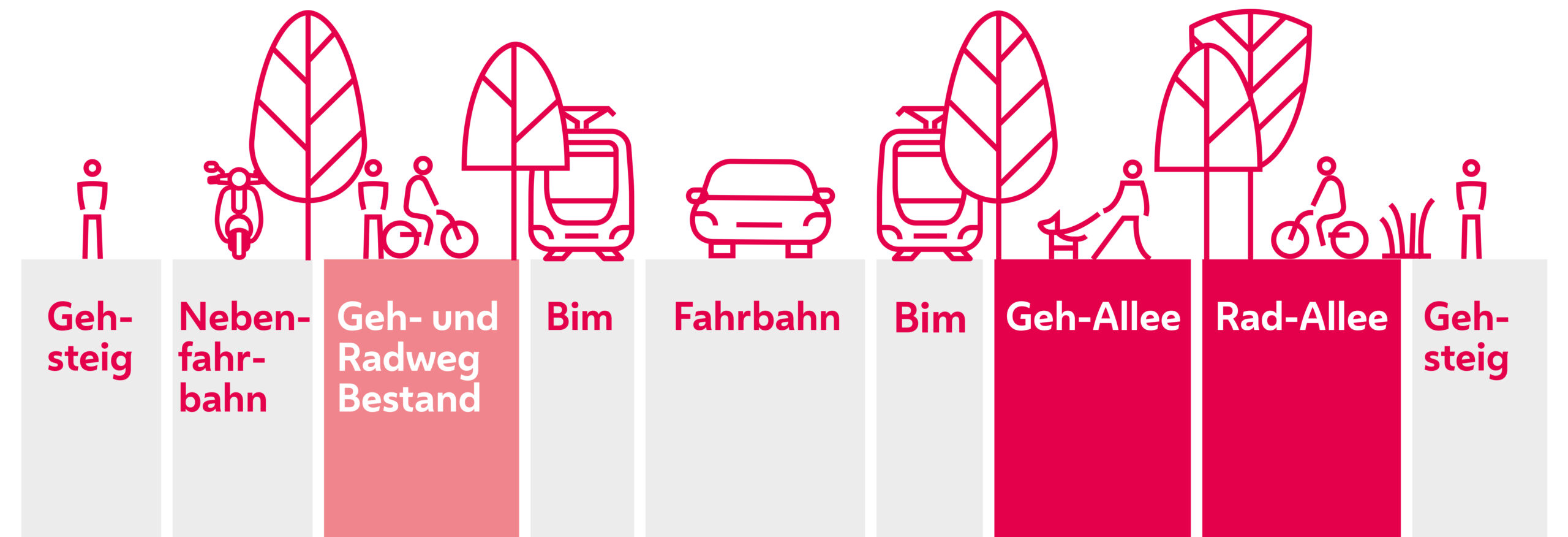
New street allocation at the Ring © Vienna Mobility Agency
The redesign follows an integrated planning approach developed in cooperation with Gehl Architects (Copenhagen). The approach is based on internationally established principles of human-centred street design. The goal is a continuous, coherent and high-quality design of pedestrian and cycling spaces along the Ring’s side areas.
Depending on usage intensity along different sections of the Ring, works will be implemented either on the inner or outer side. The main carriageways for motorised traffic and public transport will remain unchanged. From Schottenring via Universitätsring, Karl-Renner-Ring, Opernring and Kärntnerring, the city-side of the Ring will be redesigned. From Schwarzenbergplatz to the Urania, the outer side will be upgraded.
Radkompetenz member Radlobby welcomes the plans as an important step towards a contemporary Ringstraße, describing it as a “long overdue quality improvement for walking and cycling”. At the same time, it identifies further potential: bundling vehicular entry and exit points could reduce the number of crossings, improve road safety and enable a largely conflict-free flow of cycling, walking and tram traffic.
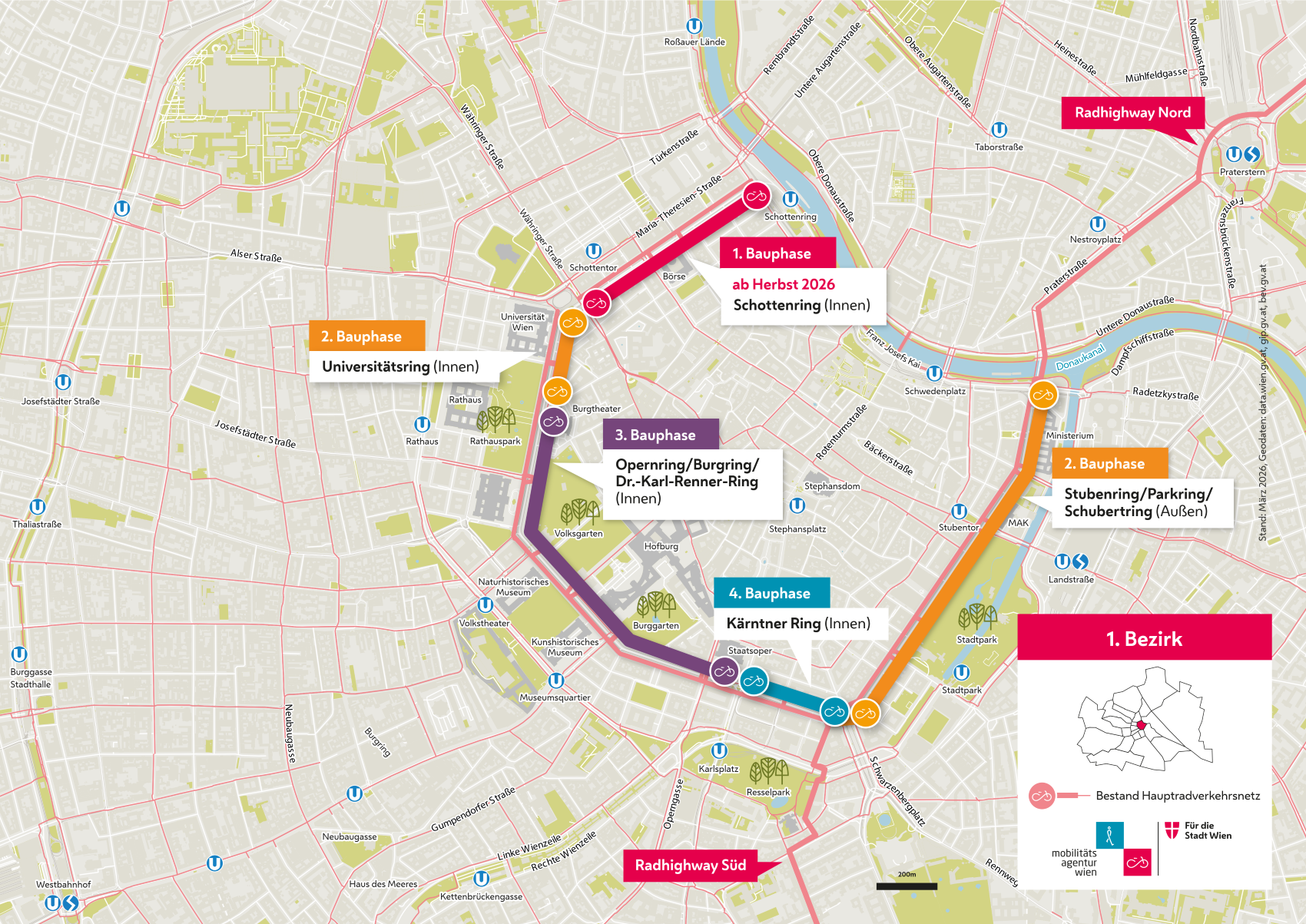
Overview of construction phases © Vienna Mobility Agency / Büro Bauer
Construction start at Schottenring
Implementation begins in autumn 2026 with the phased redesign of the approximately 700-metre-long Schottenring – on the inner side of the Ring between Schottentor and Schottenring underground stations. The outer side remains unchanged.
The main carriageways for motorised traffic and public transport will remain in place. The service road will be redesigned into a cycling boulevard with a 4.5-metre-wide two-way cycle path, meeting RVS design requirements for high-capacity cycling infrastructure in terms of width. Pedestrians will gain significantly more space along the shaded pedestrian promenade and the widened sidewalk. This creates clearly separated and clearly defined spaces for walking and cycling. In selected sections, limited vehicle access will remain where necessary, for example for garages or hotel entrances.
Rendering Schottenring/Gonzagasse © Vienna Mobility Agency / Gehl
Greening and de-sealing
Urban greening will be significantly expanded. More than 900 m² of new green areas and planting beds will be created along the inner Schottenring. A total of 12 new trees will be planted in this section alone.
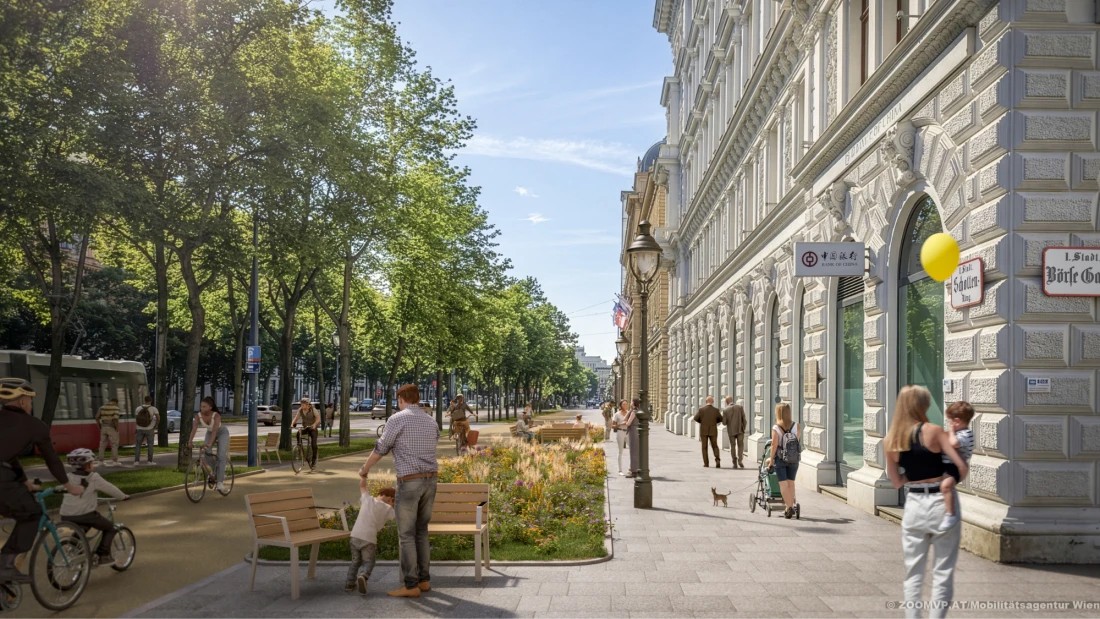
Rendering Schottenring/Börsegasse © Vienna Mobility Agency / ZOOMVP.AT
Design of cycling infrastructure
For the first time in Vienna, cycling infrastructure will be implemented in a sand-coloured asphalt surface. This design improves wayfinding and supports a clear visual separation between walking and cycling areas. At the same time, it references the historical gravel surfaces of former riding avenues and blends into the architectural context of the Ringstraße.
The existing asphalt pavement along the building frontage will be replaced by barrier-free granite paving, improving both accessibility and urban design quality.
Innovative design solutions
To improve safety at pedestrian crossings over the cycling boulevard, small paved “intermediate islands” (Zwischenlinsen) will be introduced. These provide safe waiting areas where needed and help calm cycling speeds at crossing points. Intersection areas will also be redesigned with sidewalk extensions, improving safety for all road users.
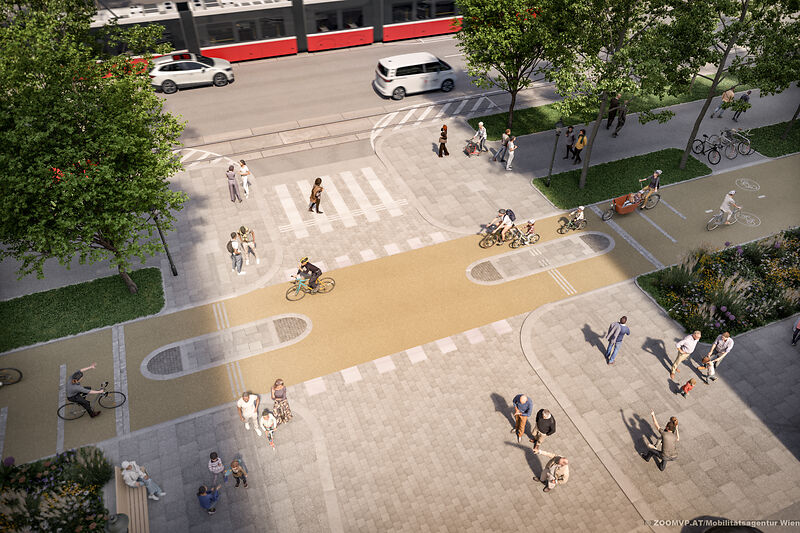
Rendering Schottenring/Heßgasse © Vienna Mobility Agency / ZOOMVP.AT
Implementation in phases
To optimise coordination, the works at Schottenring will be preceded by infrastructure works carried out by Wiener Wasser. Implementation will then proceed in several construction phases (see overview graphic above). Once completed, the Ring will feature a continuous system of separated pedestrian and cycling boulevards along large sections of the corridor. This will give one of Austria’s most important urban street spaces a contemporary infrastructure for walking and cycling, while preserving its historic character.
More information: meinring.wien
Cycling Competence Members in this article:
More articles with this member:
[crp]
Share this article:
Vienna redesigns the Ringstraße for walking and cycling
Share this article:
With thousands of pedestrians and cyclists every day, Vienna’s Ringstraße is one of the most heavily used urban street spaces in Austria. It brings together high levels of walking and cycling traffic, dense public transport services and major historic urban spaces within a very constrained corridor. The shared pedestrian and cycling paths along the Ring are increasingly reaching their capacity limits. The planned redesign of the side spaces, starting in autumn 2026, aims to respond more effectively to these diverse requirements.
Today, the shared pedestrian and cycling paths on both sides of the Ring are narrow and difficult to navigate. This regularly leads to conflicts between pedestrians and cyclists. Cycling volumes along the Ring are already very high – in 2025, an average of around 4,000 cyclists per day was counted on both the inner and outer sections of Opernring. The current layout no longer meets contemporary standards in cycling infrastructure design. As a result, the City of Vienna has decided to redesign the pedestrian and cycling infrastructure along the Ring.
Integrated planning approach
A key objective is to reduce conflicts between walking and cycling while strengthening the historic identity of the Ring. The historic pedestrian promenade between the service road and the main carriageway will once again be dedicated exclusively to walking. The current service road will be transformed into a cycling boulevard (Rad-Allee) – largely free of motorised traffic – as illustrated by Radkompetenz member Vienna Mobility Agency in the following graphic:
New street allocation at the Ring © Vienna Mobility Agency
The redesign follows an integrated planning approach developed in cooperation with Gehl Architects (Copenhagen). The approach is based on internationally established principles of human-centred street design. The goal is a continuous, coherent and high-quality design of pedestrian and cycling spaces along the Ring’s side areas.
Depending on usage intensity along different sections of the Ring, works will be implemented either on the inner or outer side. The main carriageways for motorised traffic and public transport will remain unchanged. From Schottenring via Universitätsring, Karl-Renner-Ring, Opernring and Kärntnerring, the city-side of the Ring will be redesigned. From Schwarzenbergplatz to the Urania, the outer side will be upgraded.
Radkompetenz member Radlobby welcomes the plans as an important step towards a contemporary Ringstraße, describing it as a “long overdue quality improvement for walking and cycling”. At the same time, it identifies further potential: bundling vehicular entry and exit points could reduce the number of crossings, improve road safety and enable a largely conflict-free flow of cycling, walking and tram traffic.
Overview of construction phases © Vienna Mobility Agency / Büro Bauer
Construction start at Schottenring
Implementation begins in autumn 2026 with the phased redesign of the approximately 700-metre-long Schottenring – on the inner side of the Ring between Schottentor and Schottenring underground stations. The outer side remains unchanged.
The main carriageways for motorised traffic and public transport will remain in place. The service road will be redesigned into a cycling boulevard with a 4.5-metre-wide two-way cycle path, meeting RVS design requirements for high-capacity cycling infrastructure in terms of width. Pedestrians will gain significantly more space along the shaded pedestrian promenade and the widened sidewalk. This creates clearly separated and clearly defined spaces for walking and cycling. In selected sections, limited vehicle access will remain where necessary, for example for garages or hotel entrances.
Rendering Schottenring/Gonzagasse © Vienna Mobility Agency / Gehl
Greening and de-sealing
Urban greening will be significantly expanded. More than 900 m² of new green areas and planting beds will be created along the inner Schottenring. A total of 12 new trees will be planted in this section alone.
Rendering Schottenring/Börsegasse © Vienna Mobility Agency / ZOOMVP.AT
Design of cycling infrastructure
For the first time in Vienna, cycling infrastructure will be implemented in a sand-coloured asphalt surface. This design improves wayfinding and supports a clear visual separation between walking and cycling areas. At the same time, it references the historical gravel surfaces of former riding avenues and blends into the architectural context of the Ringstraße.
The existing asphalt pavement along the building frontage will be replaced by barrier-free granite paving, improving both accessibility and urban design quality.
Innovative design solutions
To improve safety at pedestrian crossings over the cycling boulevard, small paved “intermediate islands” (Zwischenlinsen) will be introduced. These provide safe waiting areas where needed and help calm cycling speeds at crossing points. Intersection areas will also be redesigned with sidewalk extensions, improving safety for all road users.
Rendering Schottenring/Heßgasse © Vienna Mobility Agency / ZOOMVP.AT
Implementation in phases
To optimise coordination, the works at Schottenring will be preceded by infrastructure works carried out by Wiener Wasser. Implementation will then proceed in several construction phases (see overview graphic above). Once completed, the Ring will feature a continuous system of separated pedestrian and cycling boulevards along large sections of the corridor. This will give one of Austria’s most important urban street spaces a contemporary infrastructure for walking and cycling, while preserving its historic character.
More information: meinring.wien
Cycling Competence Members in this article:
More articles with this member:
[crp]